Zigbee
Low-power wireless communication protocol for connected devices, based on the IEEE 802.15.4 standard. More than 4,000 Zigbee 3.0 certified products on the market.
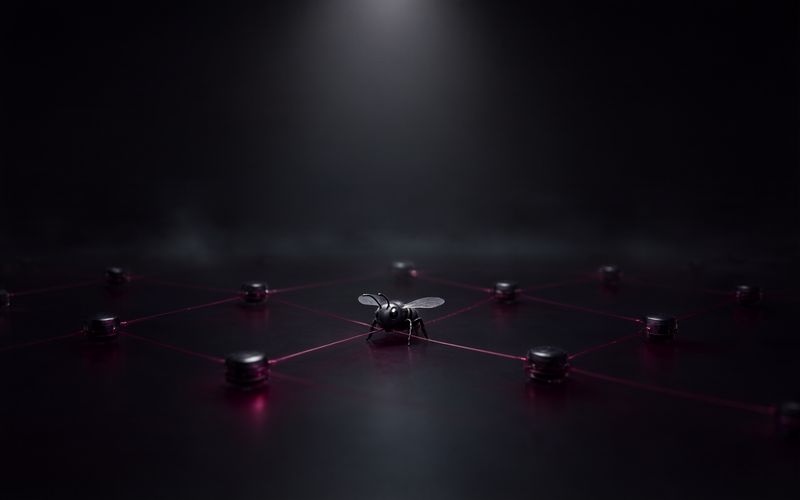
Zigbee is a low-power wireless communication protocol designed for sensor and actuator networks in the connected home and in industry. Built on the IEEE 802.15.4 standard, it operates in the 2.4 GHz frequency band and uses a mesh network architecture: every mains-powered device acts as a relay, automatically extending the network's range. More than one billion Zigbee devices are deployed worldwide (CSA, 2025).
Technical definition
Mesh network architecture
Zigbee relies on three types of nodes: the coordinator (unique, manages the network), routers (mains-powered devices that relay frames) and end devices (battery-powered devices that sleep between transmissions to save energy). This self-healing architecture automatically reroutes traffic if a router fails.
The protocol operates in the 2.4 GHz ISM band with 16 channels, a throughput of 250 kbit/s and a range of 10 to 100 meters depending on the environment. Typical latency is 15-30 ms, sufficient for home automation commands. A network theoretically supports up to 65,000 nodes.
Zigbee 3.0 and interoperability
Zigbee 3.0 (2016) unified the former application profiles (Zigbee Home Automation, Zigbee Light Link, Zigbee Building Automation) into a single interoperable standard. Any Zigbee 3.0 certified device works with any Zigbee 3.0 coordinator, regardless of manufacturer.
The Zigbee Cluster Library (ZCL) defines the standardized commands: the thermostat (setpoint, mode, scheduling), on/off (switches), level control (dimmers) and color control (RGBW lighting) clusters, and more. This standardization is what allows a Bosch thermostat to work with a Sonoff coordinator via Zigbee2MQTT.
This interactive diagram needs JavaScript.
Current challenges
Zigbee vs Matter/Thread
The arrival of Matter (2022) raised questions about Zigbee's future. The two protocols coexist: Matter uses Thread (the same IEEE 802.15.4 physical layer) for native IP and cross-ecosystem interoperability, while Zigbee keeps a mature ecosystem of 4,000+ certified products and a massive installed base. The CSA actively maintains both standards.
Open source integration
The open source community has made Zigbee accessible without any proprietary ecosystem. Zigbee2MQTT supports more than 4,000 devices from 400+ manufacturers, exposing each device via MQTT to any home automation system (Home Assistant, Node-RED, openHAB). This approach removes the dependency on proprietary bridges (Philips Hue, IKEA DIRIGERA) and enables 100% local control, with no cloud.
Standards and Specifications
IEEE 802.15.4
Low-power wireless communication standard on which Zigbee is built
Zigbee 3.0
Unified version of the Zigbee protocol guaranteeing interoperability across manufacturers
Zigbee Cluster Library (ZCL)
Library of standardized commands for Zigbee devices (thermostats, lighting, sensors)
Frequently Asked Questions
What is the difference between Zigbee and Wi-Fi for home automation?
Zigbee uses a mesh network architecture where every mains-powered device relays signals, while Wi-Fi works as a star around the router. Zigbee uses 10 to 100 times less energy, allowing battery life of several years. In return, its throughput is limited to 250 kbit/s versus several hundred Mbit/s for Wi-Fi — more than enough for home automation sensors and actuators.
Wi-Fi quickly saturates a home network (30-50 devices max), while Zigbee theoretically supports 65,000 nodes. Zigbee does, however, require a dedicated coordinator (a USB dongle such as the Sonoff ZBDongle-P or Conbee II).
Is Zigbee compatible with Matter?
Zigbee and Matter are two distinct but complementary protocols, both managed by the Connectivity Standards Alliance (CSA). Matter uses Thread as its network layer (based on the same IEEE 802.15.4 standard as Zigbee) and targets interoperability between ecosystems (Apple, Google, Amazon).
A Zigbee device is not natively Matter-compatible, but bridges (such as the Philips Hue hub) can expose Zigbee devices on a Matter network. The CSA maintains both standards in parallel.
Do you need a hub to use Zigbee with Home Assistant?
Yes, a Zigbee coordinator is required. The most popular options are USB dongles such as the Sonoff ZBDongle-P (CC2652P chip) or the Conbee II (Dresden Elektronik), paired with Zigbee2MQTT or ZHA (Zigbee Home Automation, built natively into Home Assistant).
Zigbee2MQTT offers more flexibility and supports more than 4,000 devices through an MQTT bridge. ZHA is simpler to set up but has a slightly smaller catalog of supported devices.